
Successful project delivery depends on more than tracking progress. Project Managers must continuously understand whether work is being completed on time, within budget, and according to plan.
For decades, Earned Value Analysis (EVA) has been one of the most effective project control techniques for measuring schedule and cost performance. However, traditional EVA processes often depend on manual data collection, delayed progress reports, and time-consuming calculations. By the time issues are identified, project performance may already have deteriorated significantly.
Building Information Modelling (BIM) is changing this reality. By integrating cost, schedule, and physical progress directly into a BIM environment, Earned Value Analysis becomes more accurate, visual, and responsive—providing Project Managers with real-time insights that support proactive decision-making.
What Is Earned Value Analysis?
Earned Value Analysis is a project management methodology that combines scope, schedule, and cost information to measure project performance objectively.
Rather than simply comparing budget versus expenditure, EVA evaluates how much value has actually been earned through completed work.
The methodology is built around three core metrics:
Planned Value (PV)
Planned Value represents the budgeted cost of work that should have been completed by a specific date according to the project schedule.
It answers the question:
"How much work was planned to be completed by now?"
Earned Value (EV)
Earned Value represents the budgeted cost of the work that has actually been completed.
It answers the question:
"How much value have we actually delivered?"
Actual Cost (AC)
Actual Cost represents the amount of money spent to complete the work performed.
It answers the question:
"How much have we actually spent?"
Together, these metrics provide a comprehensive picture of project performance.
The Challenge with Traditional EVA
In many construction projects, Earned Value calculations rely on:
- Manual site measurements
- Spreadsheet-based reporting
- Periodic schedule updates
- Delayed progress information
- Multiple disconnected systems
This often creates a lag between actual site performance and management reporting. As a result:
- Cost overruns may go unnoticed for weeks.
- Schedule slippage may be identified too late.
- Forecasts become less reliable.
- Corrective actions are delayed.
Project teams end up reacting to problems instead of preventing them.
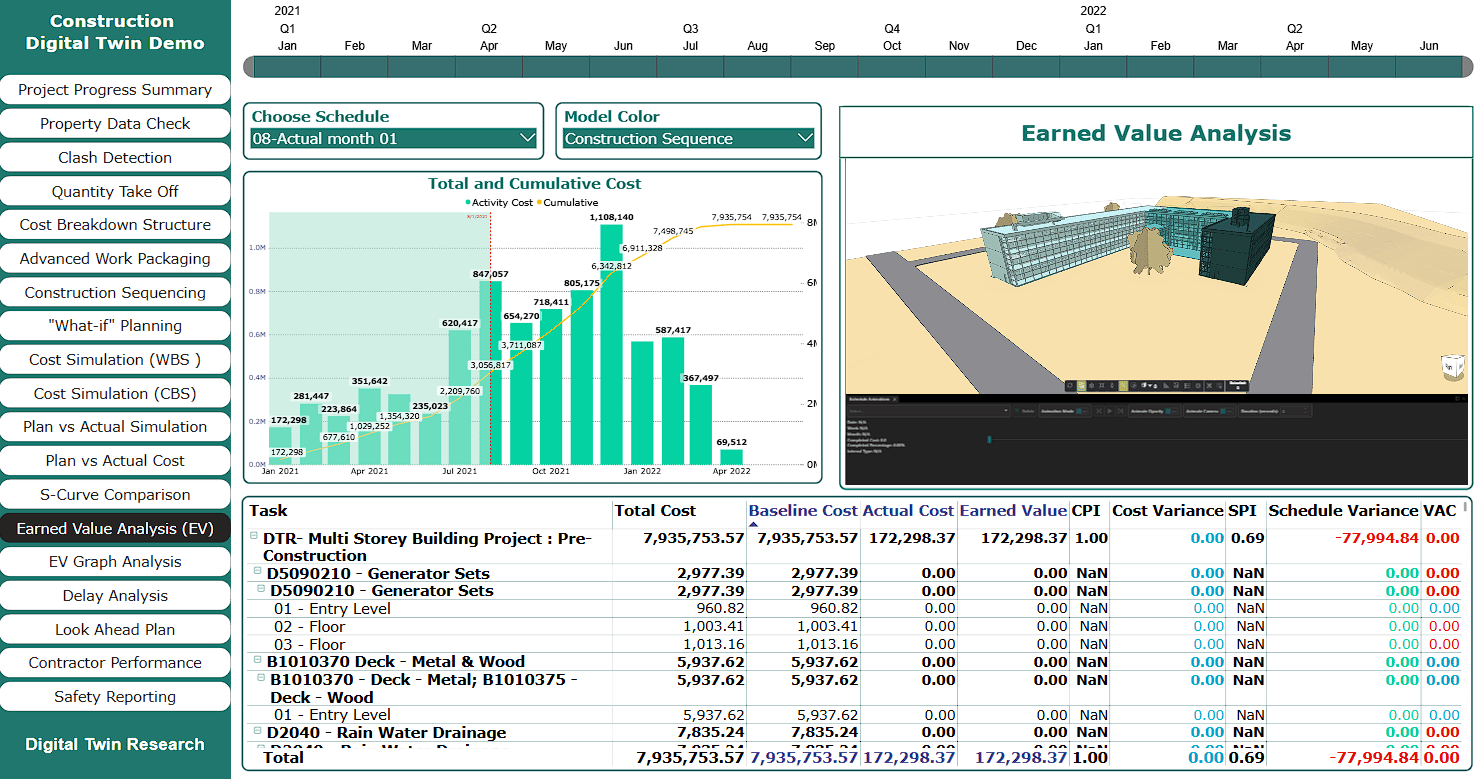
How BIM Enhances Earned Value Analysis
BIM provides a digital representation of the project where every building element can be connected to schedule activities, quantities, costs, and progress information.
When progress data is updated, the BIM model automatically reflects completed work and recalculates project performance metrics.
This transforms Earned Value Analysis from a static reporting exercise into a dynamic project control system.
Project Managers can:
- Visualize progress directly within the BIM model
- Monitor cost and schedule performance in real time
- Identify deviations earlier
- Improve forecasting accuracy
- Make informed decisions based on current project conditions
Visualising Performance Through BIM
One of the greatest advantages of BIM-based Earned Value Analysis is visualisation.
Instead of reviewing rows of data in spreadsheets, Project Managers can see project performance directly within the model.
For example:
- Completed elements can be displayed visually.
- Delayed work packages can be highlighted automatically.
- Cost and schedule performance can be represented by colour-coded dashboards.
- Progress trends can be analysed spatially across project zones.
This improves understanding across the entire project team, from executives and planners to site engineers and contractors.
The Role of the Construction Digital Twin
A Construction Digital Twin extends BIM-based Earned Value Analysis even further. By integrating:
- BIM models
- Project schedules
- Cost management systems
- Site progress data
- IoT sensors
- Field reporting tools
- Analytics platforms
Digital Twin creates a continuously updated representation of project performance. This enables near real-time monitoring of:
- Cost efficiency
- Schedule performance
- Progress trends
- Forecast completion dates
- Forecast project costs
Project Managers gain immediate visibility into emerging risks and can take corrective action before project objectives are impacted.
From Reporting to Real-Time Project Control
Traditional Earned Value Analysis has long been recognised as a powerful project management tool. However, its effectiveness has often been limited by delayed information and manual processes.
By integrating BIM, Project Management, Analytics, and Digital Twin technologies, Earned Value Analysis becomes a real-time performance management system rather than a retrospective reporting exercise.
The result is faster decision-making, improved forecasting, better stakeholder confidence, and greater control over project outcomes.
As construction projects become increasingly complex, BIM-based Earned Value Analysis is emerging as a critical capability for organisations seeking to improve cost control, schedule performance, and project delivery success.
The future of project controls lies not in reporting what happened last month—but in understanding what is happening today and predicting what will happen tomorrow.