
This is where the combination of Building Information Modelling (BIM), Project Management, Analytics, and Digital Twin technologies is transforming construction planning and control.
The Need for Real-Time Delay Analysis
Traditional project controls often identify delays after they have already affected the schedule. Progress reports are generated periodically, schedule updates are performed manually, and critical issues may remain hidden until they become significant problems.
Real-time delay analysis changes this approach.
By integrating BIM models with project schedules and actual site progress data, teams can continuously compare planned versus actual performance. Delays become visible immediately, allowing project teams to understand not only where a delay has occurred but also how it affects future activities and project milestones.
Instead of reacting to problems weeks later, teams can take corrective action when it matters most.
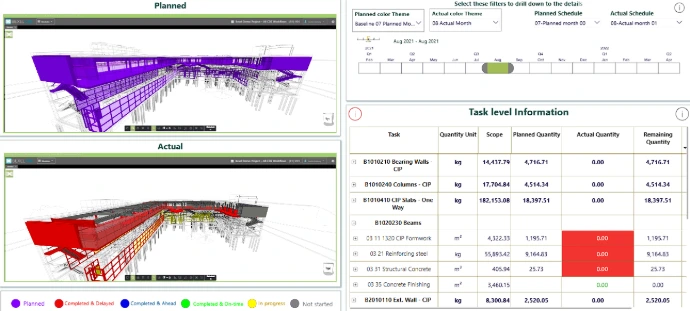
How BIM Enables Delay Analysis
BIM-enabled delay analysis combines 3D models, schedule information, and site progress updates into a single visual environment.
As actual progress data is captured from site activities, project teams can:
Compare planned and completed work in real time
Identify delayed activities and affected work zones
Visualize schedule slippage within the BIM model
Assess impacts on critical path activities
Understand how delays propagate through the project over time
This visual and data-driven approach provides significantly greater insight than traditional schedule reviews alone.
The Limitations of Traditional Planning Practices
Many construction projects still rely heavily on:
2D drawings
Primavera P6 or Microsoft Project schedules
Narrative reports
Spreadsheets
Manual progress updates
While these tools remain important, they often operate independently from one another.
Look-ahead schedules are frequently developed manually, recovery plans can take weeks to prepare, and communication between planning teams and site personnel often relies on interpreting complex schedule reports.
This creates challenges such as:
Delayed decision-making
Inconsistent project information
Limited visibility of schedule risks
Misunderstanding of site priorities
Reactive rather than proactive planning
BIM-Powered Look-Ahead Planning
Effective look-ahead planning is essential for maintaining project momentum.
With BIM-integrated planning, short-term schedules are directly connected to the project model. Upcoming activities can be visualized within the actual construction environment, making it easier for site teams to understand what needs to be completed and when.
Benefits include:
Improved coordination between trades
Better resource planning
Enhanced communication across teams
Early identification of constraints and risks
Greater confidence in execution planning
Rather than reviewing activities as lines on a schedule, teams can see future work in a clear and intuitive visual format.
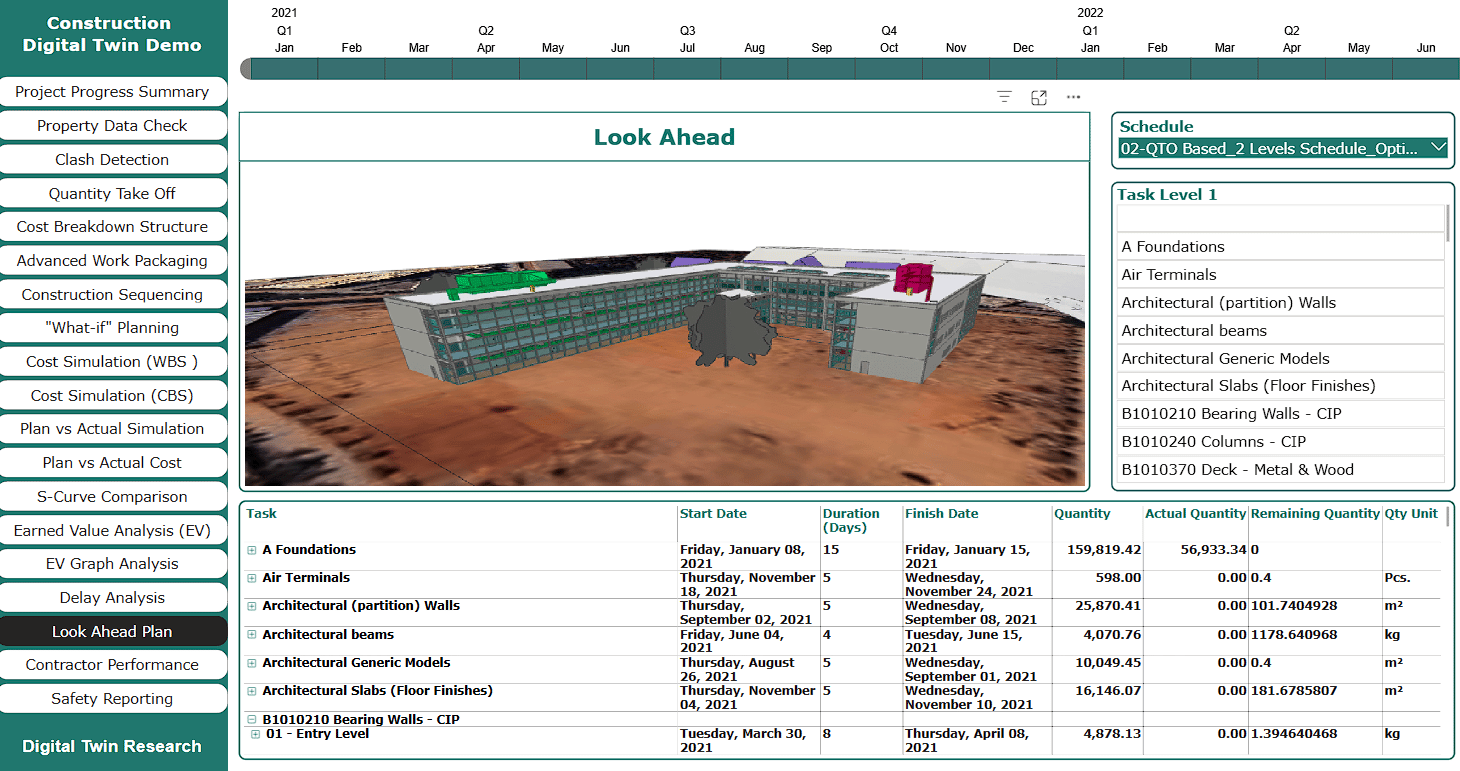
Dynamic Recovery Scheduling
When delays occur, recovery planning becomes critical.
Traditionally, developing a recovery schedule can be a lengthy process involving multiple schedule revisions, coordination meetings, and manual analysis.
A BIM-enabled environment accelerates this process significantly.
Planning teams can test different recovery scenarios, evaluate alternative construction sequences, and visualize proposed solutions before implementation.
Potential recovery strategies may include:
Resequencing activities
Increasing workforce allocation
Introducing additional resources
Adjusting work areas
Modifying construction methods
Each scenario can be assessed visually and analytically, helping teams select the most effective recovery strategy while minimizing disruption to the project.
Creating a Shared Understanding Across Stakeholders
One of the greatest advantages of integrating BIM, Project Management, and Analytics is the creation of a common visual language.
Engineers, planners, contractors, project managers, and site teams all work from the same information source.
Instead of relying solely on complex schedules and reports, stakeholders can see project progress, upcoming activities, delays, and recovery plans directly within the model.
This improves collaboration, reduces misunderstandings, and supports faster decision-making.
The Role of the Construction Digital Twin
A Construction Digital Twin takes planning and project controls to the next level.
By continuously integrating BIM models, schedules, site progress updates, analytics, IoT data, and field information, the Digital Twin provides a live representation of project performance.
This enables:
Real-time delay monitoring
Continuous look-ahead planning
Rapid recovery schedule development
Visual risk assessment
Data-driven decision-making
Project teams gain the ability to respond quickly to changing site conditions while maintaining alignment with project objectives.
Moving from Reactive to Proactive Project Control
The future of construction planning is no longer about identifying delays after they happen. It is about predicting issues, understanding their impact, and implementing solutions before they affect project outcomes.
By enabling real-time delay analysis, look-ahead planning, dynamic recovery scheduling, and visual risk mitigation, BIM and Construction Digital Twin technologies help project teams stay agile, informed, and resilient throughout the project lifecycle.
For Planning Managers, this represents a shift from reactive schedule management to proactive project control—driving better decisions, improved collaboration, and more successful project delivery.